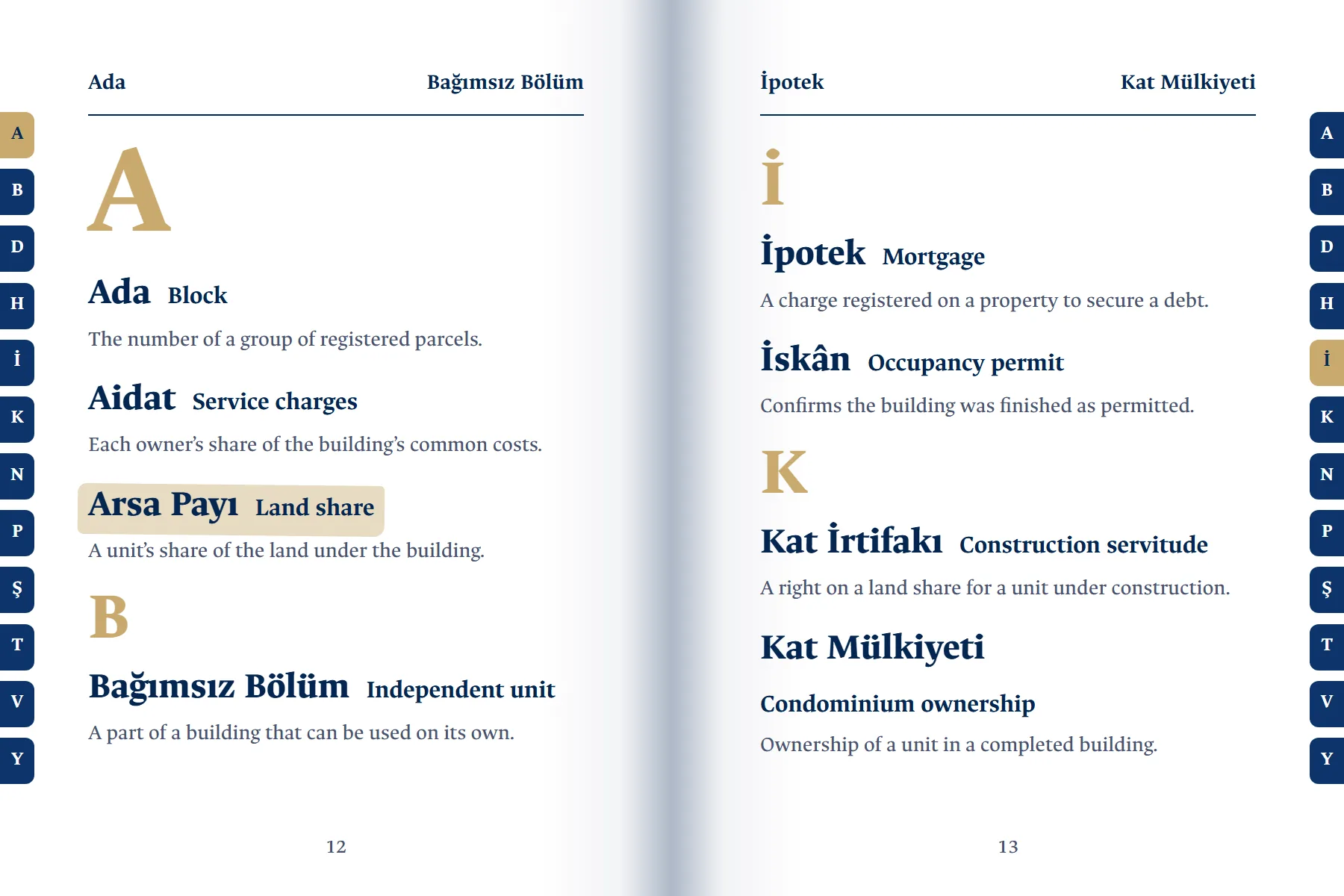
18 terms in four groups. Open any term to see its explanation and what it means for you; you can open more than one at a time.
In English or Turkish, or pick a letter from the index on the page’s edge.
{{qCount}}
We could not find this term in the glossary.
Try writing it in Turkish or in English, or only part of the word. You can also ask a Link consultant about it directly.
In Türkiye, ownership of real property is acquired by registering it in the land register (tapu sicili), whose records are kept electronically by the General Directorate of Land Registry and Cadastre (TKGM). The title deed (tapu senedi) is a document issued to the owner from this register.
What counts is the property’s current register, not the paper. Encumbrances such as a mortgage or an attachment may be registered or lifted after the deed is issued, so the current records are checked before buying.
Example: The owner can authorize a prospective buyer to view the property’s records through Web Tapu or e-Devlet, and the buyer then sees them in their own account.
How to read the title deed · Why is a copy of the deed not enough ?
It is established by the landowner for the independent units of a building that is to be built or is under construction, in preparation for condominium ownership (Kat Mülkiyeti) once the building is complete. Each unit’s land share and its future number are written in the declarations section (Beyanlar) of the register.
A unit registered this way is tied to a land share in a building that has not yet received an occupancy permit for the whole building. What matters is knowing the building’s stage and what the agreement says about completion.
It is created by an official deed and by registration in the land register. If the unit is registered under a construction servitude, the registration is converted to condominium ownership on the basis of an occupancy permit (İskân) issued for the whole building, either automatically by the land registry or at the request of one of the owners.
This registration reflects a unit in a completed building that has received its occupancy permit. Even so, checking the mortgages, attachments and annotations in the current register remains necessary.
Land shares are allocated to the units in proportion to the value of each unit according to its location and size, and they do not change later if a unit’s value rises or falls. The share passes with the unit when it is sold or inherited.
The land share is an inseparable part of your unit, and it is also the basis on which your share of most of the building’s common expenses is calculated.
A mortgage is created by an official contract and registered in the land register. It can secure an existing or a future debt, and the property does not have to belong to the debtor themselves. Its details (amount, rank and date) are written in the mortgages section of the register.
A mortgaged property can be sold without the creditor’s consent, but the transfer of ownership does not change the mortgage unless otherwise agreed; that is, the mortgage remains on the property. So before the transfer, ask about lifting any registered mortgage: how and when it will be done.
When a property is attached, the enforcement office (icra dairesi) notifies the land register of the attachment, its amount and the creditor’s name; it is written in the annotations section (Şerhler) of the property’s register page, and the register is likewise notified when it is lifted.
A registered restriction can be invoked against anyone who acquires a right in the property after it was registered; that is, the buyer takes the property subject to the attachment unless it is lifted.
Rights arising from contracts can be annotated in the register, such as construction in return for a land share, a promise to sell the property, a lease, and rights of purchase, pre-emption and repurchase. Restrictions on the right of disposal, such as attachments and court decisions, are also annotated.
Once an annotation is registered, it binds anyone who later acquires a right in the property. So ask for an explanation of any note you find in the annotations section before signing.
The Zoning Law requires a building permit for all buildings within its scope, and any alteration to a permitted building needs a new permit.
The building permit concerns the stage before and during construction; it is not the occupancy permit (İskân). If a building breaches the zoning rules, the land register is notified and this is written in the declarations section, and it is removed only after the competent authority reports that the violation has been remedied.
The certificate is issued by the authority that issued the building permit (the municipality or the governorship), after it checks that the building conforms to the permit and its attachments and that there is no technical obstacle to its use. İskân is the common name; the legal name is the building use permit.
A permit issued for the whole building is linked to converting the registration from construction servitude to condominium ownership. The Zoning Law states that buildings that have not obtained an occupancy permit are not connected to electricity, water and sewerage until they obtain one.
DASK is the common name for compulsory earthquake insurance (Zorunlu Deprem Sigortası). Every dwelling and every independent unit within the scope of the Condominium Law is subject to it, and it is renewed every year. Land registry offices do not carry out the registration unless a valid policy is shown to exist on the date of the transaction.
Under the amendment to the insurance general conditions published in the Official Gazette on 21 August 2026, the insurance contract ends when the sale is registered, and the land registry office checks that there is an insurance contract for the new owner. So the insurance is arranged in the buyer’s name before the appointment.
The Condominium Law defines an independent unit as a part of a building that is fit for use on its own and can be the subject of separate ownership. It calls the whole property the “main property” (Anagayrimenkul), and the spaces outside the unit that are allocated directly to it “annexes” (Eklenti).
The independent unit number in the land register is what identifies your unit among the building’s units, so match it against the unit’s number in the contract and the approved architectural plan.
The block number is used together with the province, district, neighborhood and parcel number to identify the land on which the building stands; this is the information TKGM’s parcel inquiry service asks for. In some locations a parcel has no block number.
The block and parcel numbers help you confirm where the land is. The results of the parcel inquiry service, however, are for information only and are not used in official transactions.
The land arrangement regulations distinguish between the cadastral parcel (kadastral parsel), registered under the cadastre laws without any zoning arrangement, and the zoning parcel (imar parseli), which has been rearranged according to the zoning plan.
The units of a single building share portions of the same parcel’s land, which is why the parcel number appears in the register of every unit.
The zoning regulation defines it as the clear area between the walls; it does not include balconies, terraces, open projections, annexes or common areas, nor columns and technical shafts.
It is the closest to the space you actually use inside the unit. When comparing offers, make sure you are comparing net area with net area.
The zoning regulation distinguishes between the unit’s gross area (within its outer perimeter), the total gross area, to which the annexes are added (toplam brüt), and the overall gross area, to which the unit’s share of the common areas is added (genel brüt).
When a gross figure is quoted, ask which gross area it is. All of these areas are shown for each unit in the approved architectural plan attached to the building permit.
The fee is calculated on the declared sale value, which may not be lower than the property’s value for property tax (emlak vergisi değeri), and it is collected from the seller and from the buyer separately. The rate currently applied is twenty per thousand (2%) for each party, and it can be changed by presidential decision. For a unit registered under a construction servitude, it is calculated on the full sale value.
Declaring a value lower than the real one may lead to the difference being assessed later with a penalty. Know the fee for your transaction before the appointment, and if it is agreed that one party will bear the whole amount, have that put in writing.
Example: If the declared sale value is 10,000,000 lira, each party’s fee at the current rate is 200,000 lira.
The Notaries Law requires powers of attorney for land registry transactions to be drawn up by the notary in full form (düzenleme şeklinde), not merely by certifying the signature, and to bear the signature of the person granting them. Outside Türkiye, Turkish consuls carry out the duties of a notary.
If you cannot attend, the power of attorney is prepared before the appointment, with wording that covers the required transaction. If it will be issued outside Türkiye by an authority other than a Turkish consulate, ask in advance about the conditions for the land registry to accept it.
Unless otherwise agreed, the owners share the wages of the doorkeeper, the heating attendant, the gardener and the guard equally, and the costs of insurance, maintenance, repair and management in proportion to their land shares. An owner is not exempted from them by giving up the use of the common areas.
If payment is late, a late-payment penalty of 5% per month is due by law, and a statutory mortgage may be registered on the unit if the debt remains. So ask about the amount of the charges and what they cover, and about any arrears on the unit.
This content is for general awareness; check the details of each transaction with the competent authority. Sources last reviewed: 4 November 2026. Glossary sources
A question about a term or a stage of buying ? Contact the Link Property team.
WhatsApp opens with your message ready; nothing is sent until you press send.