


In short
- What the land register holds, and why the current register is relied on rather than the paper copy.
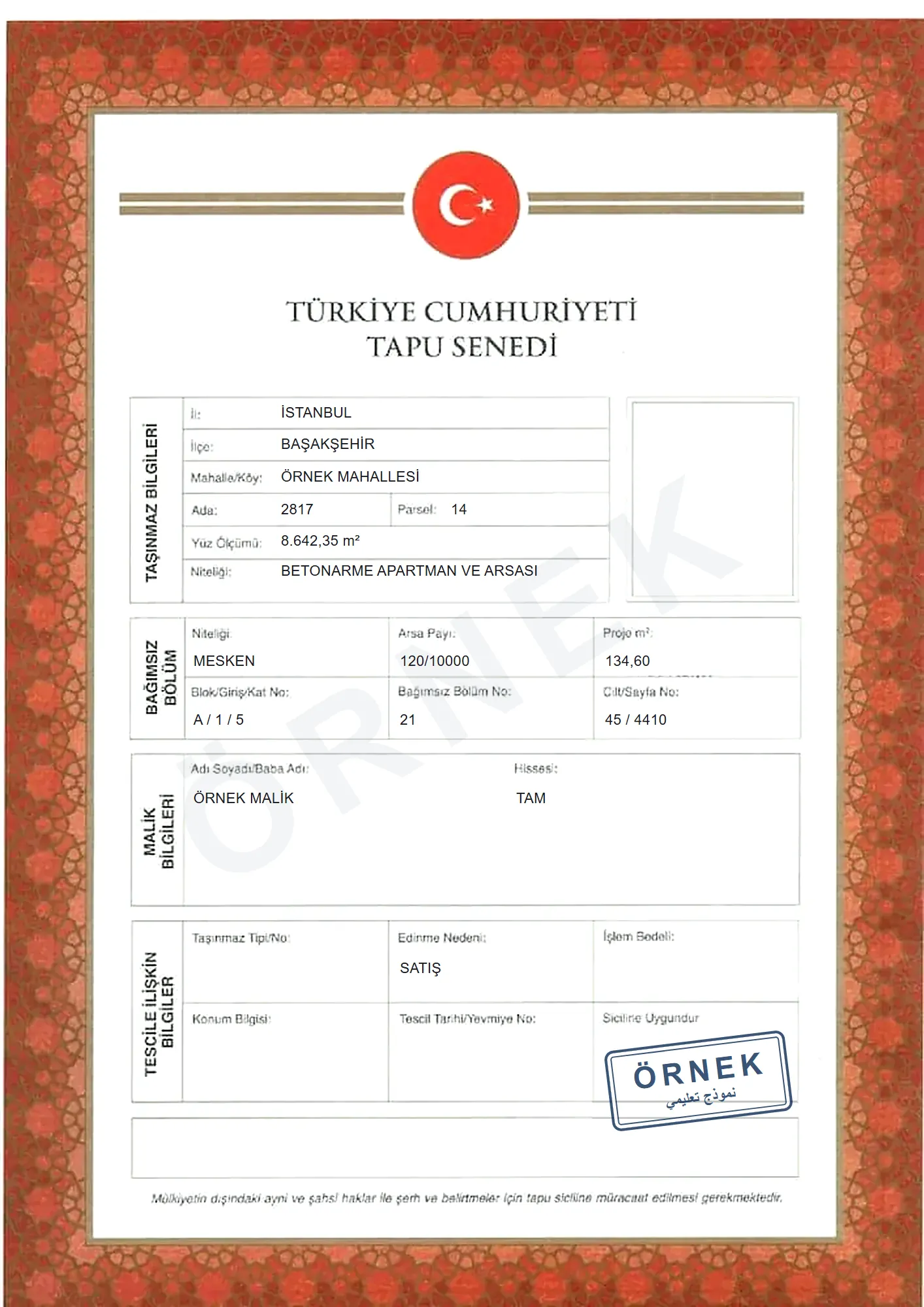
- How to read the fields of a title deed, on an image of a blank deed in its official format.
- The difference between Kat İrtifakı and Kat Mülkiyeti, and what to check in each case.
- What İskân is, and how it relates to construction and to the type of registration.
How do you read a title deed ?
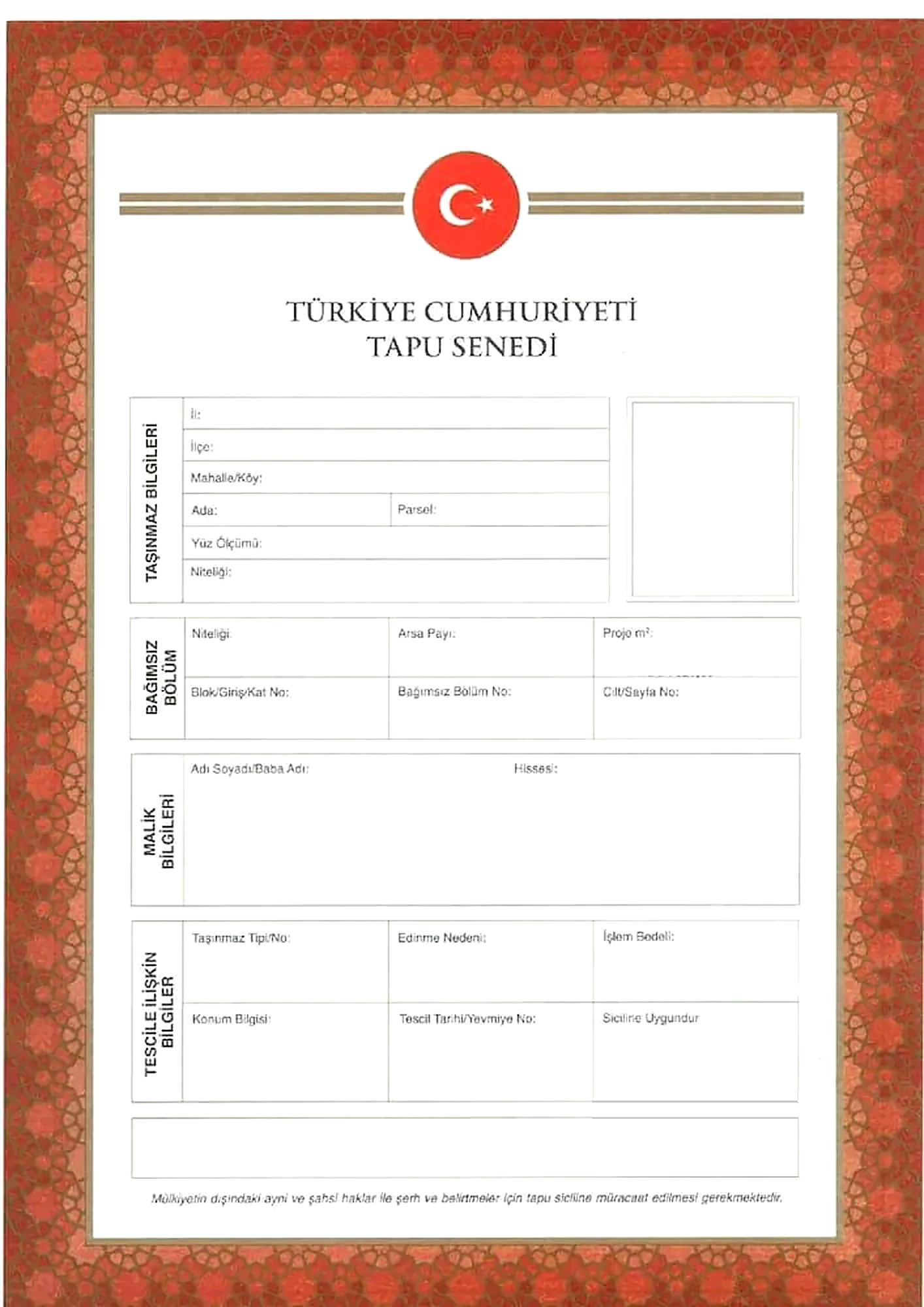
An image of a blank title deed in its official format, with its clarity enhanced. Tap any number on the image to see what the field means, or read the list below the image.
{{dpTitle}}
{{dpTr}}{{dpText}}
The numbered fields in the sample
- Property location (İl · İlçe · Mahalle/Köy): The province, district and neighborhood or village where the property is located. Together with the block and parcel numbers, these are the details TKGM’s parcel inquiry service asks for.
- Block and parcel number (Ada · Parsel): They identify, in the land register, the land on which the building stands. In some locations a parcel has no block number.
- Parcel area (Yüz Ölçümü): The area of the whole registered parcel, that is, the land on which the building stands, not the area of your apartment.
- Description of the main property (Niteliği (Taşınmaz Bilgileri)): The register’s description of the parcel and what stands on it, such as land or a building. This description is updated when the building receives its occupancy permit.
- Description of the unit (Niteliği (Bağımsız Bölüm)): The register’s description of the unit itself, such as a residence (Mesken), a shop or an office.
- Land share (Arsa Payı): Your unit’s share of the building’s land, expressed as a share of the total land shares. It goes with the unit when it is sold, and most common expenses are calculated on its basis.
- Unit area in the project (Proje m²): The unit’s area in square meters according to the architectural project. Compare it with the area stated in the offer and the contract, and ask whether it is net or gross.
- Unit location and number (Blok/Giriş/Kat No · Bağımsız Bölüm No): The building block, entrance, floor and independent unit number. This number identifies your apartment among the building’s units, so match it against its number in the contract and the approved plan.
- Volume and page (Cilt/Sayfa No): The volume and page numbers of the property’s page in the land register, used to look up its entry.
- Owner and share (Adı Soyadı/Baba Adı · Hissesi): The registered owner’s name and father’s name, and their share of the ownership. If more than one owner appears, find out each one’s share and who will be a party to the sale.
- Reason for acquisition (Edinme Nedeni): How ownership passed to the current owner, such as a sale or an inheritance.
- Transaction value (İşlem Bedeli): The value declared in the transaction at registration. The title deed fee is calculated on the declared value, which may not be lower than the property’s value for property tax.
- Registration date and number (Tescil Tarihi/Yevmiye No): The date on which the transaction was registered and its number in the journal of the land registry office.
- Conforms to the register (Siciline Uygundur): The phrase “conforms to the register”, followed on a real deed by the date of issue, the signature of the authorized officer and the directorate’s seal. We removed the signature and seal from this image.
- The statement printed at the bottom of the deed (Mülkiyetin dışındaki ayni ve şahsi haklar…): The statement says that for real and personal rights other than ownership, and for annotations and declarations, reference is made to the land register. In other words, the deed does not show every encumbrance; the current register is what counts.
A copy of the title deed alone does not prove the current status of all rights and encumbrances. Rights arise through registration in the register, and encumbrances such as mortgages, attachments and annotations are written in the register’s sections and may change after the deed is issued. The owner can authorize a prospective buyer to view the property’s records through Web Tapu or e-Devlet.
Kat İrtifakı and Kat Mülkiyeti
The two types are two stages in the life of the same building, not two grades of quality. The type of registration shows the unit’s legal status, but on its own it is not enough to judge the property.
Kat İrtifakı · Construction servitude
A right on a share of the land for each unit in a building that is yet to be built or under construction, serving as the basis for condominium ownership once it is completed. The land share and the unit’s future number are written in the declarations section.
Kat Mülkiyeti · Condominium ownership
Private ownership of an independent unit in a completed building, tied to its land share and to the common areas. It is created by an official deed and by registration in the land register.
| Aspect | Kat İrtifakı | Kat Mülkiyeti |
|---|---|---|
| What it represents | A right on a land share for a unit in a building to be built or under construction | Ownership of an independent unit in a completed building, with its land share and the common areas |
| How it is created | By an official deed and registration in the land register | By an official deed and registration in the land register |
| Link to the occupancy permit | Converted to condominium ownership on the basis of an occupancy permit issued for the whole building, automatically or at the request of one of the owners | Reflects a building that has received its occupancy permit |
| What is written in the register | The land share and the unit’s future number, in the declarations section | The independent unit and its land share |
| Basis of the title deed fee on sale | The full declared sale value | The declared sale value |
What to check in each case ?
If the unit is registered under a construction servitude
- The current construction stage, and the completion date as written in the agreement.
- The building permit (Yapı Ruhsatı) and the approved project on which the unit is being built.
- The unit’s future number and land share, as shown in the declarations section.
- The annotations registered in the current register, such as a promise to sell or construction in return for a land share.
If the unit is registered under condominium ownership
- That the unit matches its number and area in the approved architectural plan.
- The mortgages, attachments and annotations in the current register.
- Any registered declaration of a zoning violation in the declarations section.
- The shared service charges (Aidat) and any arrears on the unit.
What is İskân ?
İskân is the common name for the building use permit certificate (Yapı Kullanma İzin Belgesi). It is issued by the authority that issued the building permit, that is, the municipality or the governorship, after it checks that the building has been completed in line with its permit and approved projects and that no technical reason prevents its use. The Zoning Law provides for a decision on the application within 30 days.
The permit can be issued for finished parts of a building, but converting the registration from construction servitude to condominium ownership depends on a permit issued for the whole building. The law states that buildings that have not been granted the permit are not connected to electricity, water and sewerage until they obtain it.
- 1Building permitIssued after the building’s projects are approved, before work starts
- 2ConstructionThe building is built according to the permit and its projects
- 3Occupancy permit (İskân)The permitting authority checks conformity
- 4Land register updateThe property description is updated, and the construction servitude is converted to condominium ownership
The diagram summarizes the relationship as set out in Articles 21, 30 and 31 of Zoning Law No. 3194 and Articles 3 and 10 of Condominium Law No. 634; the details for each building differ according to its file.
Frequently asked questions
Is a copy of the title deed enough to know the property’s current status ?
No. Real rights arise through registration in the land register and take their rank from its date, and encumbrances such as mortgages, attachments and annotations are written in the register’s sections. The deed reflects the records at the time it was issued, so the current register is checked before buying.
Source: Turkish Civil Code No. 4721, Articles 997 and 1022, Land Registry Regulation (Tapu Sicili Tüzüğü), Article 12
How does a buyer view a property’s records before buying ?
The owner can give the buyer permission to view the property’s records through Web Tapu or the property authorization service on e-Devlet, and the buyer then sees them in their own account. Anyone who shows a legitimate interest is also entitled to request copies from the register at the land registry office.
Source: Web Tapu — General Directorate of Land Registry and Cadastre (TKGM), TKGM services on the e-Devlet portal, Turkish Civil Code No. 4721, Article 1020
Can you buy a unit registered as Kat İrtifakı ?
Yes. It is a registered right that is transferred by sale, and the title deed fee is then calculated on the full declared sale value. What matters is knowing the building’s stage and what the agreement says about completion, and checking the current register.
Source: Condominium Law No. 634, Articles 2 and 3, Law on Fees No. 492, Article 63
Who issues İskân, and when ?
It is issued by the authority that issued the building permit (the municipality or the governorship) once the building is complete and its conformity has been checked, and the law provides for a decision on the application within 30 days.
Source: Zoning Law No. 3194, Article 30, Planned Areas Zoning Regulation (Planlı Alanlar İmar Yönetmeliği), Article 64
Is a Parsel Sorgu result proof of ownership ?
No. The service’s terms of use state that its results are for information only and are not used in official transactions. It helps you find where the parcel is, but for ownership and encumbrances the register is the reference.